BCA vs. B.Tech (Computer Science): Which Degree Is Right for You?
BCA vs. B.Tech (Computer Science): Which Degree Is Right for You?
Choosing your path in the tech world is a huge decision. You're passionate about computers, but the alphabet soup of degrees is confusing. Two of the most common options are BCA (Bachelor of Computer Applications) and B.Tech (Computer Science).
At a glance, they seem similar—both are about computers, right?
Yes, but their approach, depth, and the career paths they open are very different. Think of it this way: a BCA graduate is trained to be an expert user and creator of software applications, while a B.Tech graduate is trained to be an engineer who can design and build the entire system, from the hardware logic up to the software.
Let's break down the key differences to help you decide which one is the perfect fit for your goals.
📊 At a Glance: BCA vs. B.Tech (CS)
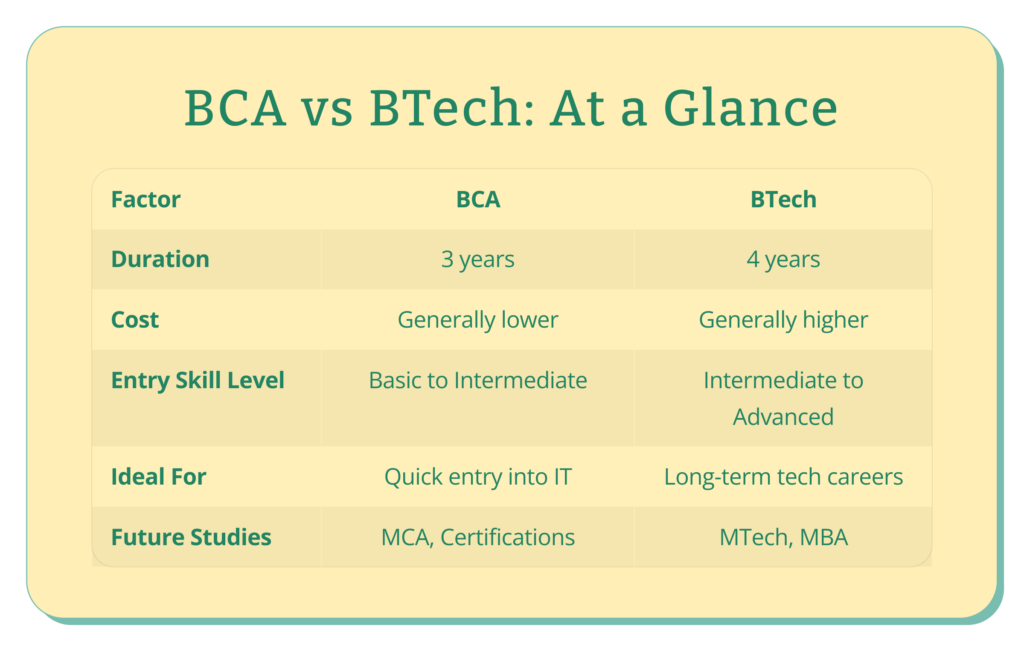
| Parameter | BCA (Bachelor of Computer Applications) | B.Tech (Computer Science) |
| Full Name | Bachelor of Computer Applications | Bachelor of Technology in Computer Science |
| Duration | 3 Years | 4 Years |
| Core Focus | Software Applications & Programming | Engineering Principles & Core CS Theory |
| Eligibility | 10+2 from any stream (often requires Math/CS) | 10+2 with Science (PCM) is mandatory |
| Key Subjects | C, C++, Java, Web Development, Database Management, OS | Data Structures, Algorithms, Advanced Math, AI, Computer Architecture |
| Ideal For | Students who want a quicker, application-focused entry into the IT industry. | Students with a strong interest in math, logic, and the deep, technical "how" of computers. |
🎓 Course Structure & Focus
This is the biggest difference between the two.
BCA: The Application Specialist
A BCA is a 3-year degree that is all about the application side of computers. The curriculum is designed to make you proficient in programming languages, software development, database management, and web development.
You will learn: How to build websites, manage databases, develop software, and understand networking.
The focus is: "How to use technology to build solutions." It's practical, hands-on, and job-oriented from day one.
B.Tech (CS): The Engineering Architect
A B.Tech is a 4-year engineering degree. It's more rigorous and theoretical. It covers everything a BCA does, but then goes much deeper. You'll study the "why" and "how" behind the applications.
You will learn: Advanced Data Structures & Algorithms, complex mathematics (calculus, discrete math), computer architecture (how a processor is designed), compiler design, and artificial intelligence.
The focus is: "How to engineer technology." It’s about problem-solving from a foundational, scientific level. You're not just building a house; you're learning to design the blueprint, test the materials, and lay the foundation.
💼 Career Opportunities & Salary
Both degrees lead to great jobs in IT, but they often start at different points and have different long-term trajectories.
After BCA
BCA graduates are readily hired for many essential roles in the tech industry.
Common Job Titles: Software Developer, Web Developer, System Analyst, IT Support Specialist, Database Administrator.
Career Path: The path is typically focused on software development. To reach senior engineering or management roles, many BCA graduates pursue a Master of Computer Applications (MCA). A BCA + MCA is often considered equivalent to a B.Tech by many companies, opening up a wider range of opportunities.
After B.Tech (CS)
A B.Tech (CS) degree is often seen as a gateway to a wider range of technical roles, especially in top-tier product companies (like Google, Microsoft, Amazon) and R&D.
Common Job Titles: Software Engineer, Data Scientist, AI/ML Engineer, Cybersecurity Analyst, R&D Engineer, DevOps Engineer.
Career Path: The engineering-focused curriculum prepares you for specialized, high-growth fields. The 4-year program is internationally recognized as a full engineering degree, making it simpler to pursue a Master of Science (MS) abroad.
When it comes to salary, B.Tech (CS) graduates often command higher starting packages. This is due to the 4-year curriculum, the engineering-focused skill set, and the higher barrier to entry (PCM requirement).
📈 Higher Education: The Next Step
After BCA: The most common and recommended path is an MCA. This 2-year post-graduate degree bridges the gap between BCA and B.Tech, diving deep into the theoretical computer science subjects. You can also opt for an MBA if you wish to move into management.
After B.Tech (CS): You have several options. You can pursue an M.Tech for deep technical specialization, an MS from a foreign university (a very popular route), or an MBA to pivot into product management or leadership.
🤔 Which One Should You Choose?
There is no "better" or "worse" option—only the right fit for you.
✅ Choose BCA if:
You are not from a Science (PCM) background in 10+2.
You want a quicker, 3-year path to a job in the IT industry.
You are more interested in the application and programming side of computers than in deep theory or hardware.
You are willing to pursue an MCA later to enhance your career prospects.
✅ Choose B.Tech (CS) if:
You have a strong background in Physics, Chemistry, and Math (PCM).
You love math, logic, and complex problem-solving.
You are fascinated by the deep, internal workings of computers, not just the software.
You are aiming for a career in a specialized field like AI, Data Science, or R&D at a top-tier product company.
You can commit to a 4-year engineering program.
Both paths can lead to a successful and rewarding career in technology. The key is to choose the one that aligns with your interests, your academic background, and your long-term ambitions.
This video provides a detailed comparison to help you understand the differences in career paths and skills between B.Tech and BCA.


No comments